

A press release is useful when you have a defined development to announce and verified information that helps someone report it. A new service, a significant project or a documented business change may justify one. The format works best when it provides a clear account of what has happened and why it matters to a particular audience.
Before drafting a headline, check the substance of the announcement. An expert explanation, a customer guide or a direct update to existing customers may serve the purpose more effectively.
Identify the development in one sentence
Write down what has changed, who is involved, where it applies and when it takes effect. Keep the statement factual. Describing a service as exciting does not explain the development.
A fictional training company introducing evening workshops would need confirmed details about participants, dates, location and booking arrangements. Whether that makes a media story depends on its relevance beyond the company’s own wish to announce it.
Establish who needs the information
Existing customers may need a direct service update. A trade publication may be interested in operational implications. A regional journalist may need a specific local consequence or connection.
Choose the audience before deciding how widely to distribute the release. Our guide to pitch relevance explains how publication research should influence the angle. An identical email sent to unrelated desks rarely demonstrates that fit.
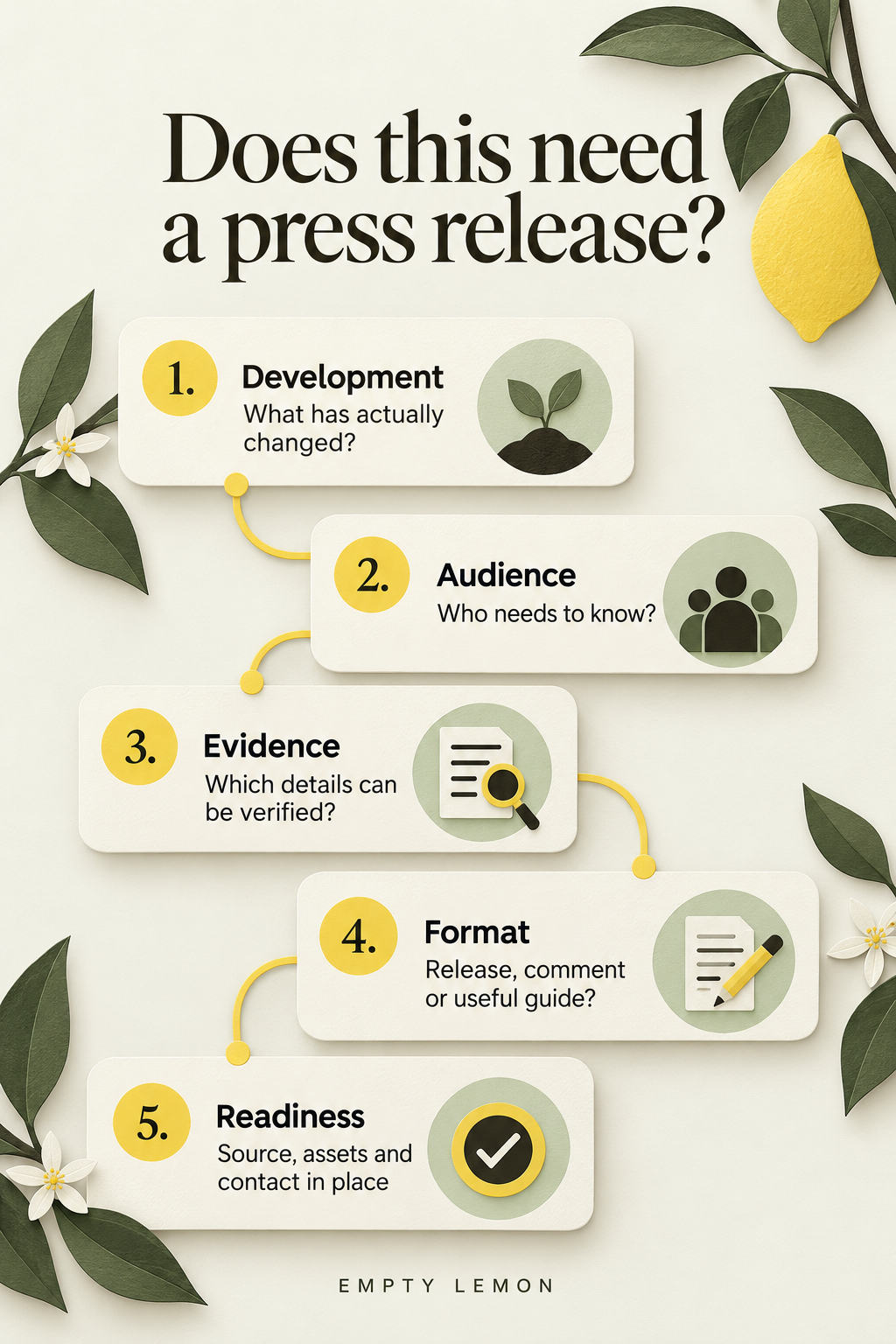
Choose a format that fits the material
A release provides a consistent factual account for relevant approaches. An expert comment may suit a request to interpret an existing issue. A guide is often better when the value lies in a detailed answer that remains useful over time.
The fictional training company could prepare an announcement alongside a separate guide to choosing a workshop. Each needs a distinct purpose. Do not manufacture urgency when the material has no timely reason for a journalist to cover it.
Prepare the supporting facts
- Check names, roles, dates, locations and availability.
- Keep evidence for significant claims and figures.
- Identify a named source who can answer questions.
- Prepare approved images with captions, credits and permissions.
- Provide a working contact route and realistic availability.
A quotation should add explanation or perspective. A specific account of a decision is generally more useful than a statement that the company is delighted. Check that the spokesperson is comfortable discussing the reasoning behind it.
Agree the timing and responsibilities
Confirm that the announcement is approved and that its supporting page or service is ready. Decide who responds to enquiries and who checks additional information requested by a journalist.
Do not assume that writing an embargo date creates an agreement. Establish arrangements with the recipient before sharing information on that basis. When the development is already public, explain what additional access or context you can offer.
Test the release before sending it
Ask someone outside the project to explain what has changed and why the intended audience should care. If they struggle, revise the facts and angle before polishing the language.
A well-prepared release supports a suitable story; it does not guarantee coverage. Start with finding a supported PR story, or talk to Empty Lemon about preparing the right approach.