

A small team’s marketing plan needs to fit the time and resources available. A long list of channels can make the plan look ambitious while leaving the people delivering it unsure what deserves attention first.
Use a 90-day period as a manageable planning window. It is a way to organise work and review progress; it does not mean every marketing activity should produce its full result within three months.
Choose one priority the business needs to support
Start with a specific business need and the audience involved. You might need more suitable enquiries for an established service, clearer understanding of a new offer or stronger relationships with an existing customer group.
A fictional training provider could focus on helping managers understand when a team workshop is suitable. That gives the team a concrete communication task. “Increase engagement everywhere” provides much less guidance about what to produce.
Write a plain objective and decide how progress could be observed. Use a baseline where available. Avoid selecting a precise growth target solely because it sounds demanding; the target needs a reason and a consistent way to measure it.
Check what is already helping or getting in the way
Review the main service page, recent enquiries, existing content and the current route to contacting the business. Look for a practical obstacle you can address before increasing promotion.
If prospects misunderstand the offer, the first useful task may be a clearer explanation. If the contact form fails or the team cannot respond reliably, attracting more visitors may amplify a problem.
List reusable material as well: an approved case study, a useful guide, a knowledgeable spokesperson or a customer question that deserves a fuller answer. Your plan can build on those assets instead of starting every activity from scratch.
Match the workload to real capacity
Agree who can contribute and how much time they can protect. Include research, specialist input, approval, distribution and reporting alongside the writing or design. These less visible tasks still need an owner.
Then choose a small number of activities that support the same objective. For the fictional training provider, that might mean improving the workshop page, developing one comparison guide and sharing relevant sections through an existing customer channel.
Add media outreach only where there is a credible angle and a prepared source. A marketing plan does not need every channel to earn its place.
Use three stages to organise the work
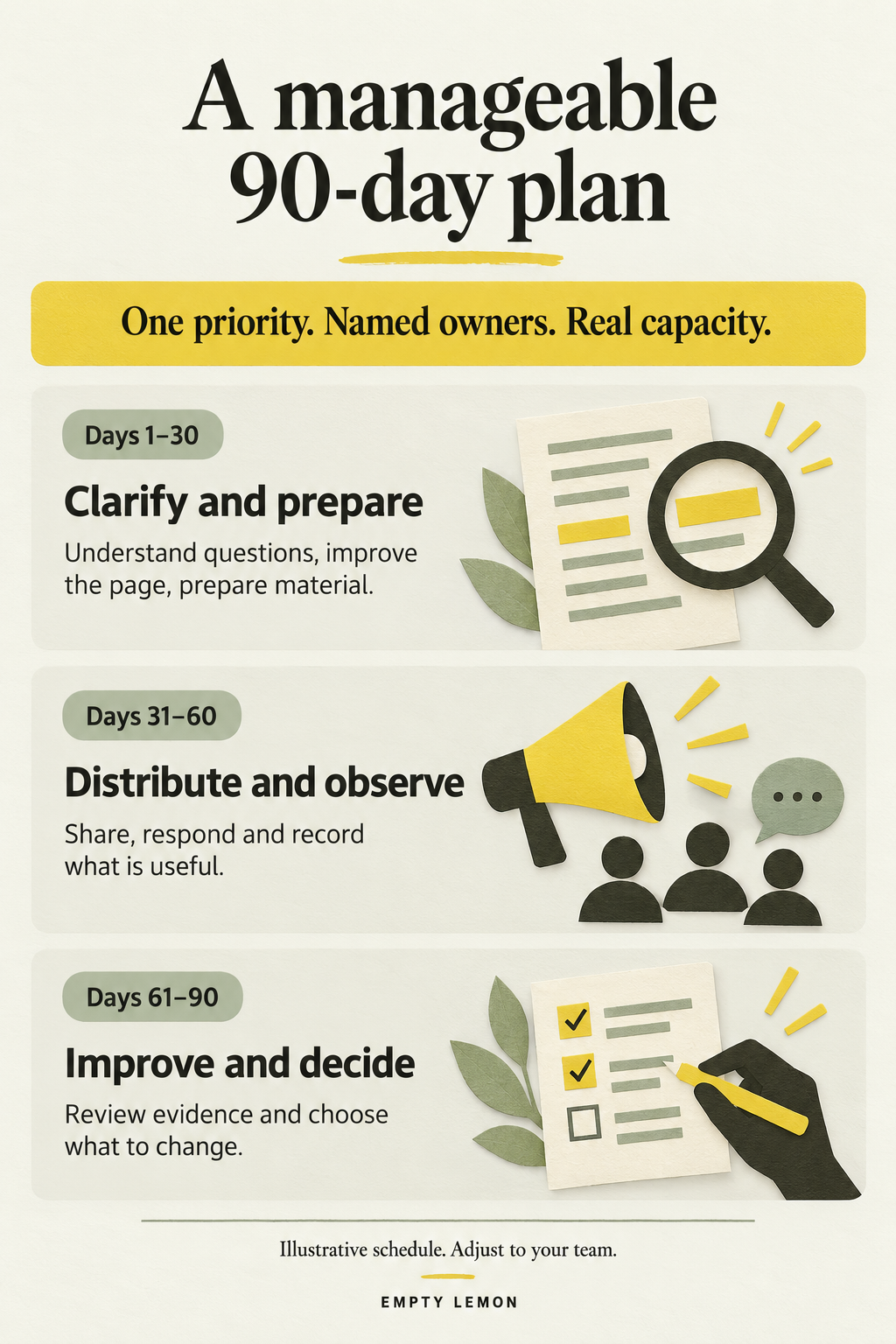
The following is an illustrative schedule. Change the pace to suit your business and the availability of the people involved.
- Days 1–30: clarify and prepare. Review the audience’s questions, improve the main page, agree the measurement approach and prepare the core material.
- Days 31–60: distribute and observe. Share the material through suitable channels, respond to questions and record what people find useful or unclear.
- Days 61–90: improve and decide. Revisit the explanation and distribution, assess the available evidence and choose what to continue, change or stop.
Allow time between publication and review where the activity needs it. Do not abandon a useful guide simply because it has not produced an immediate enquiry. Equally, avoid continuing an activity without asking whether it is reaching the intended audience.
Give every task an owner and a definition of done
Use a simple working plan with the task, purpose, owner, due date, required input and evidence of completion. “Improve the service page” is too broad to track on its own. Specify which questions it needs to answer and who will check the result.
Keep an explicit list of work outside this period. When a new idea arrives, compare it with the agreed priority and available capacity before adding it. If it must take precedence, decide what will move or stop.
For businesses serving several audiences through separate brands, agree which team and website own each activity. Our guide to marketing two related brands explains how to keep those roles clear.
Review evidence and make a decision
At each checkpoint, ask what was delivered, what the audience did and what remains uncertain. Read performance figures alongside the enquiries and feedback the team actually receives.
For example, more page visits accompanied by the same suitability question may mean the explanation still needs work. A lower volume of better-matched enquiries might support the original objective more effectively than a larger number of unsuitable ones.
Finish the period with a short record of what you learned and what the next plan should change. If you need help choosing priorities and turning existing knowledge into useful activity, talk to Empty Lemon about a practical marketing plan or explore our services.