

When a business expands, its marketing has to explain more than what is new. Customers need to understand how the new offering relates to the one they already know.
Launching a second brand can help organise a growing range of products. It also creates a challenge: giving each brand a recognisable purpose while making their relationship clear.
The launch of Padel Holidays alongside Padel Breaks provides a useful example of that balancing act.
Why introduce a second travel brand?
In a launch announcement dated 14 August 2026, Padel Breaks Limited introduced PadelHolidays.com as a sister platform for premium, longer-stay and tailor-made padel travel.
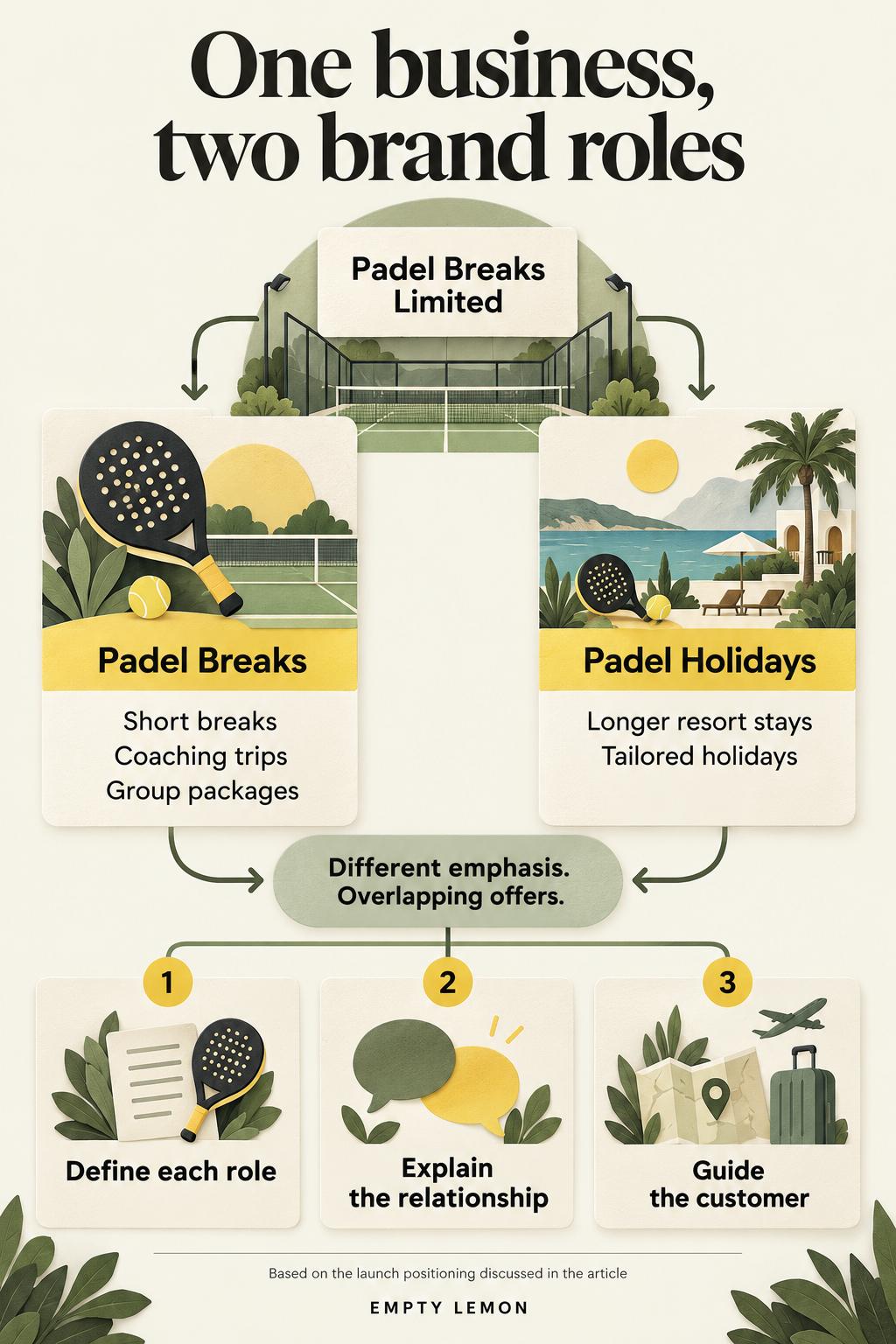
The announcement described PadelBreaks.com as continuing to offer short breaks, coaching trips, group packages and activity-led travel. PadelHolidays.com would give longer resort stays and more tailored itineraries a dedicated platform. Both would operate under the same business. Read the launch announcement.
From a marketing perspective, the distinction is about the kind of trip a customer is trying to organise.
Someone arranging a short sporting weekend with friends may begin with different questions from a couple planning a longer resort holiday. The first enquiry might centre on group logistics and playing time. The second might give accommodation, dining and time away from the court equal weight.
Those are illustrative customer needs, rather than published findings about either brand’s audience. They show why a business might choose to give related services different starting points.
Give each brand a clear job
A second website needs a stronger justification than a different name and colour scheme.
Its homepage, navigation, photography and descriptions should help visitors recognise whether they have arrived in the right place. That requires a clear proposition: who the offering is for, what it helps them do and why they should consider it.
In this example, Padel Breaks provides the broader padel-trip platform, while Padel Holidays presents a dedicated proposition around resort stays and tailored holidays.
There is overlap. Both brands can serve groups, offer coaching and combine accommodation with time on court. The useful distinction is therefore one of emphasis, rather than a rigid division between products.
That matters when writing marketing copy. Describing one brand as exclusively for short trips, or the other as exclusively for luxury travellers, could create expectations that the actual range does not support.
Explain the relationship openly
Related brands should not leave customers guessing about who operates them.
Padel Holidays’ own About page identifies it as a specialist travel brand operated by Padel Breaks Limited. That provides a factual foundation for explaining the relationship, rather than relying on similar names or visual clues. See the company’s explanation.
For businesses managing several brands, the practical lesson is straightforward: make ownership and responsibilities easy to find.
A visitor should be able to understand which business they are contacting and where to find the relevant booking or service information. Consistent explanations across About pages, contact details and customer communications help prevent avoidable confusion.
Build content around different decisions
Separate brands create an opportunity to address different customer questions. They also create a risk of publishing near-identical material across two websites.
A stronger content plan starts with the decisions people need to make.
For a short group trip, useful subjects might include agreeing a budget, matching playing abilities and organising transfers. For a longer resort stay, readers may need help balancing coaching with downtime, assessing accommodation or planning for a non-playing companion.
These subjects can overlap without requiring duplicate articles. Each piece should have a defined audience, a practical purpose and information that earns its place.
The same approach applies to media pitches. A sports publication may be interested in coaching and club travel. A travel-trade title may want to understand customer suitability or package arrangements. The underlying business facts should remain consistent, while the story addresses the publication’s readers.
Measure whether the distinction helps
A launch announcement explains a strategy. It does not establish that the strategy has succeeded.
To assess a two-brand approach, a business could examine whether enquiries are reaching the appropriate team, whether customers understand the relationship and whether each website attracts interest in its intended offering.
Enquiry quality, booking conversion and recurring customer questions would be useful measures. They would need to be tracked over time before making claims about improved performance.
The wider lesson is that a second brand needs a clear role throughout the customer journey. Its purpose should be visible in the proposition, supported by the content and understood by the people responding to enquiries.
For businesses considering a similar expansion, the starting question is simple: what customer need would the new brand make easier to understand?