

A service page should help someone decide whether your business is a sensible fit for their needs. That means explaining the offer clearly enough for a reader to understand what they would be enquiring about.
A striking headline and a contact button can open the conversation, but important unanswered questions may leave the visitor unsure whether to continue. Review the page against the decisions a prospective customer needs to make.
Say what the service is and who it helps
Use a heading that identifies the service in language customers recognise. Follow it with a short explanation of the problem it addresses and the people or organisations it suits.
A fictional consultancy offering project support might work with small teams preparing a specific kind of operational change. Describing that situation helps a reader assess relevance. Calling the service a complete transformation solution leaves much more to interpretation.
Be accurate about suitability. If the work depends on a certain starting position or serves only particular locations, make that clear where it affects the decision. Useful boundaries can reduce avoidable misunderstandings.
Explain what is included
Describe the actual work rather than relying on broad promises. Identify the main components, the deliverables a customer can expect and any substantial exclusions or optional elements.
For the fictional consultancy, that might mean a review meeting, a written plan and a defined number of follow-up sessions. Those details should reflect the actual offer when writing a real page. Do not add a package simply because a tidy list looks persuasive.
Explain flexible elements in plain language. If the scope is agreed after an initial conversation, say what informs that decision and how the proposed work will be confirmed.
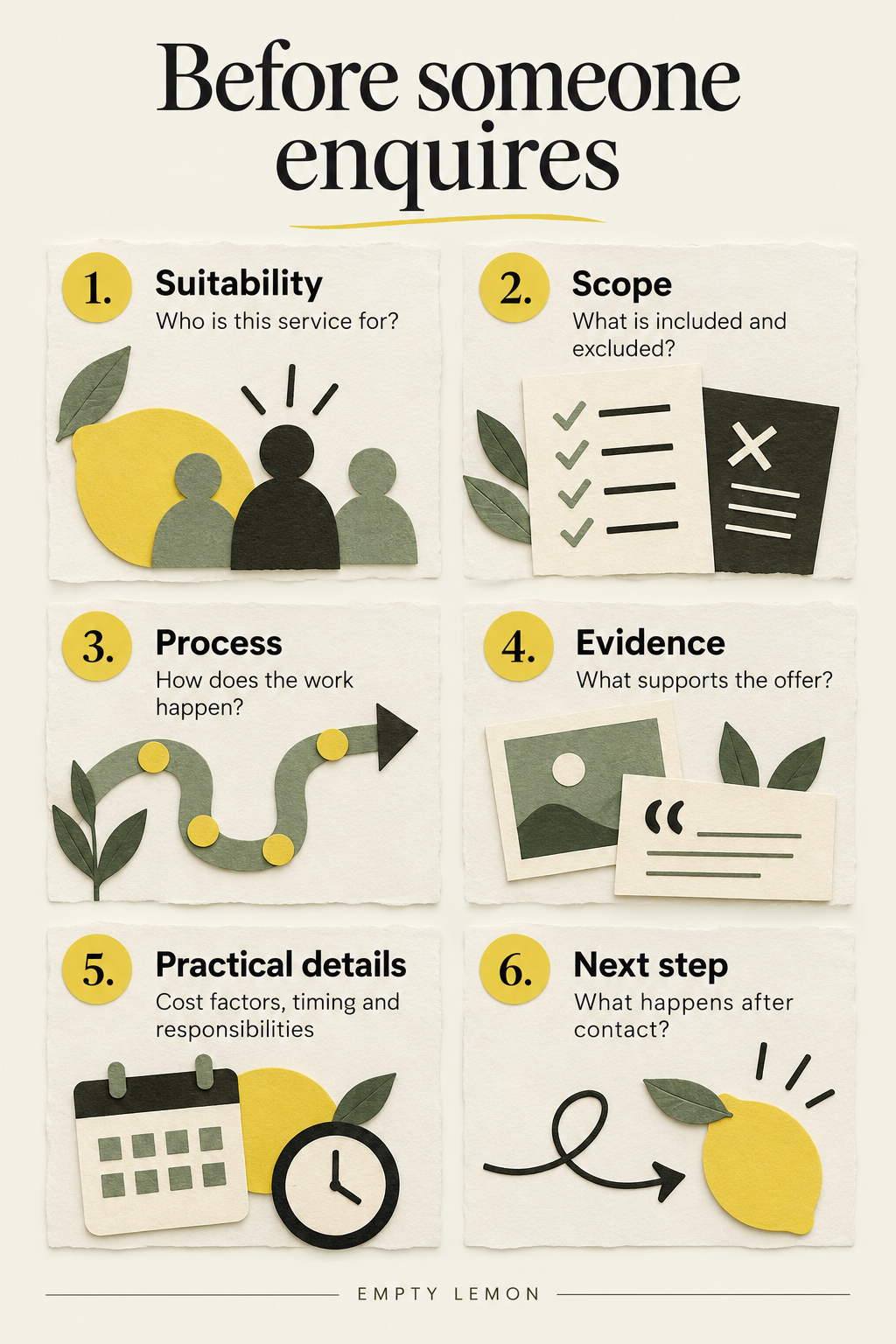
Show how the process works
Give the reader a realistic outline from enquiry to delivery. Explain what happens first, what information you need and where approvals or decisions sit.
A short sequence is usually enough: initial discussion, assessment, agreed scope, delivery and review. Add detail where your process differs in a way that matters to the customer. For example, explain if work cannot start until access to a site or a named decision-maker is available.
Where timing depends on scope, availability or customer input, explain those dependencies. A confident promise that is routinely qualified later can create more uncertainty than an honest explanation at the start.
Provide evidence that answers a buying question
Use relevant examples, clear credentials or approved customer feedback to support the offer. Explain how the evidence relates to the service rather than placing a set of logos beside a general claim.
A case study about handling a difficult delivery constraint may be useful to someone facing the same issue. A testimonial about friendliness may provide reassurance but cannot substantiate a claim about measurable performance.
Check names, quotations and permissions before using them. If you have no suitable evidence for a statement, revise the statement or gather the evidence. Avoid filling the gap with an invented example presented as client work.
Answer practical questions where they arise
Cost, location, suitability, responsibilities and support arrangements often influence whether someone enquires. Give the clearest truthful answer you can. If pricing is bespoke, explain the factors that shape a quote and what someone needs to provide.
Place essential answers in the relevant section. A short FAQ can help with remaining questions, but should not become a hiding place for important scope information.
Our guide to using customer enquiries to find content ideas offers a practical way to identify the questions your current page misses. Some should be answered directly on the service page; more complex comparisons may deserve a separate guide.
Make the next step predictable
Tell people what happens when they use the contact route. Explain the information that would help you respond and the type of conversation or assessment that follows. State a response time only if the business can reasonably maintain it.
Use a call to action that describes the action, such as asking about availability or discussing a brief. Check that the destination matches the promise and that the form asks only for information needed at that stage.
Test the page with someone unfamiliar with the service. Ask them to explain who it is for, what is included and what would happen after an enquiry. Their unanswered questions form a useful editing list.
Google’s helpful-content guidance encourages assessing whether a page helps its intended audience achieve a goal. For a service page, a practical goal is an informed next step. Contact Empty Lemon if your offer needs a clearer explanation.